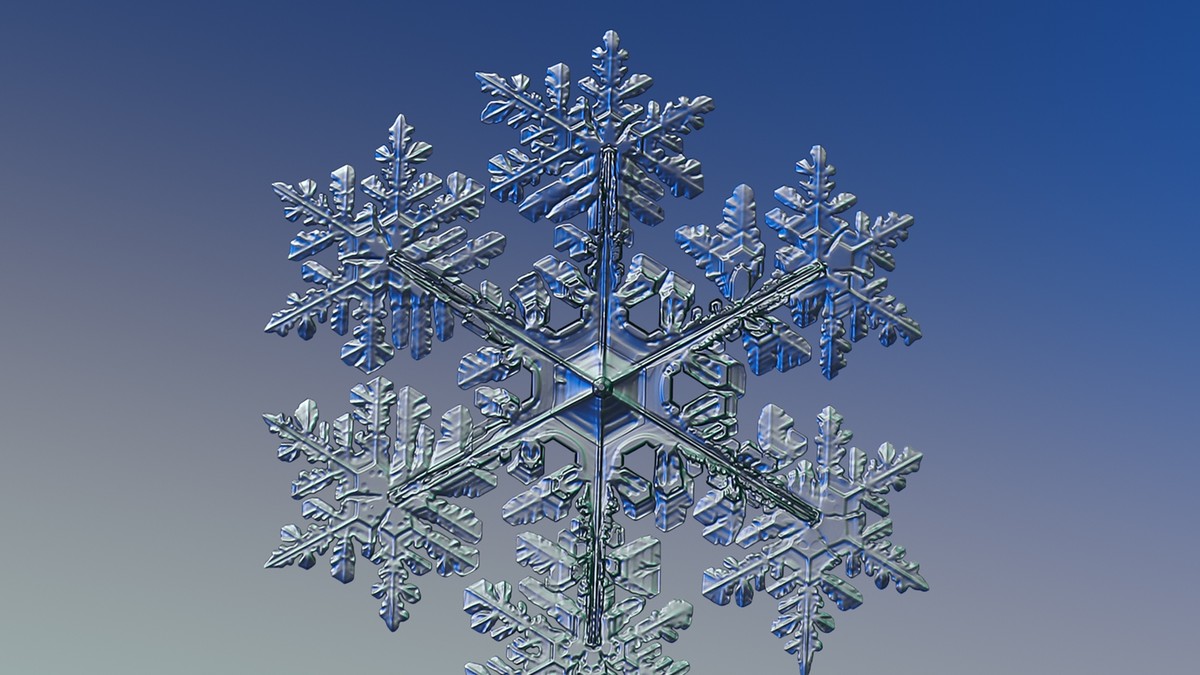
❄️ Solid State Cryo-Meteorology Monograph
An exhaustive crystallographic examination of solid atmospheric hydrometeors. We evaluate the Nakaya morphology diagram, hexagonal molecular ice lattices, dendritic growth kinetics, graupel accretion, and the thermodynamic sounding profiles separating snow, sleet, and freezing rain.
Solid precipitation represents the tangible physical manifestation of molecular order emerging from atmospheric chaos. Every individual snowflake that drifts toward Earth’s surface is a pristine single crystal of ice (or an aggregate of multiple crystals) whose intricate, symmetrical hexagonal geometry records the exact thermodynamic history of its journey through the clouds. From the gossamer delicacy of stellar dendrites to the dense, opaque pellets of graupel and the crystalline beads of sleet, solid hydrometeors exhibit a staggering variety of structural morphologies governed by the physics of crystal facet growth and surface diffusion.
The molecular foundation of all natural snow crystals is the hexagonal ice lattice (Ice Ih). In an Ice Ih crystal, each oxygen atom is tetrahedrally bonded to four neighboring oxygen atoms via hydrogen bonds, forming planar rings of six water molecules. This microscopic hexagonal molecular symmetry dictates the macroscopic six-fold rotational symmetry observed in all atmospheric snow crystals. However, while molecular symmetry enforces six-fold coordination, the infinite morphological diversity of snowflakes—the classic aphorism that ‘no two snowflakes are alike’—is driven by subtle fluctuations in ambient temperature and supersaturation experienced as the growing crystal tumbles through inhomogeneous cloud layers.
1. The Nakaya Morphology Diagram: Thermodynamic Facet Selection
The systematic relationship between environmental conditions and snow crystal morphology was unraveled in the 1930s by Japanese physicist Ukichiro Nakaya at Hokkaido University. Nakaya constructed the world’s first low-temperature cloud chamber, growing artificial snow crystals under meticulously controlled conditions of temperature and supersaturation. His experimental findings, summarized in the renowned Nakaya Morphology Diagram, revealed that snow crystal habits undergo dramatic, non-monotonic transitions governed almost entirely by ambient temperature:
| Temperature Window (°C) | Basic Crystal Habit | Specific Morphological Forms | Governing Facet Growth Kinetic | Visual Aesthetic |
|---|---|---|---|---|
| 0°C to -4°C | Thin Hexagonal Plates | Simple plates, basal tablets | Prism faces grow faster than basal faces | Flat, smooth hexagonal discs without branching |
| -4°C to -10°C | Prismatic Columns & Needles | Solid columns, hollow columns, long needles | Basal faces grow faster than prism faces | Slender hexagonal pencils, sheaf-like needle bundles |
| -10°C to -22°C | Planar Dendrites & Sectors | Stellar crystals, fern-like dendrites, plates | Prism faces dominate; explosive edge branching | Classic, highly intricate six-pointed holiday snowflakes |
| -22°C to -40°C | Columns, Prisms & Pyramids | Bullet rosettes, hollow prisms, capped columns | Basal growth re-emerges; low vapor availability | Complex composite columns, aerodynamic multi-branched clusters |
2. Dendritic Branching Kinetics and the Magono-Lee Classification
The most visually celebrated snowflakes—the stellar dendrites (from the Greek dendron, meaning tree)—form exclusively within the optimal thermal growth corridor between -12°C and -18°C, peaking sharply at -15°C. This temperature coincides precisely with the thermodynamic maximum in the vapor pressure difference between supercooled liquid water and ice described by the Clausius-Clapeyron equation.
In this ‘dendritic growth zone’, ambient water vapor supersaturation with respect to ice regularly exceeds 15% to 25%. Under such elevated vapor densities, the growth of a hexagonal ice plate becomes unstable due to the Mullins-Sekerka morphological instability. Because the six sharp corner vertices of a hexagonal plate stick out further into the surrounding vapor field than the flat edge faces, water vapor molecules diffuse toward these protruding tips along steeper concentration gradients. This phenomenon, known as the lightning rod effect of crystal growth, causes the six corners to grow rapidly outward into primary branches.
As these primary branches elongate, instabilities repeat along their flanks: tiny perturbations near the tips attract elevated vapor fluxes, giving birth to secondary side branches oriented precisely at 60-degree angles relative to the main stem. This process repeats hierarchically to produce tertiary branches, yielding the exquisite, fern-like architecture of dendritic snow. In 1966, Choji Magono and Chung Woo Lee expanded Nakaya’s work into the comprehensive Magono-Lee Classification System, standardizing 80 distinct solid precipitation categories including capped columns (columns with thin hexagonal plates growing like wheels on each end), rimed dendrites, and radiating assemblages of bullet rosettes.
3. Graupel and Soft Hail: Riming Thermodynamics
While pristine snow crystals grow via pure vapor deposition, solid hydrometeors frequently undergo severe microphysical modification through riming. When a dendritic snowflake or ice crystal descends through a dense mixed-phase cloud containing abundant supercooled liquid droplets (diameters 10–30 micrometers), it collides with these droplets. Upon impact, the supercooled droplet freezes rapidly onto the ice surface.
If riming is light, the underlying hexagonal geometry remains clearly identifiable beneath a scattering of frozen beads. However, if riming is vigorous and sustained, accreted droplets accumulate rapidly, filling the interstices between dendritic branches and completely encasing the original crystalline embryo in a dense, conical or spherical mantle of opaque ice. This heavily rimed hydrometeor is designated graupel (also termed soft hail or snow pellets).
Graupel pellets typically measure 2 to 5 millimeters in diameter, possessing a low bulk density (approximately 0.1 to 0.4 g/cm³) due to millions of microscopic air pockets trapped between rapidly frozen rime droplets. Graupel is soft and compressible; when striking the ground, it bounces and frequently shatters into fine white fragments. Graupel plays a paramount role in storm electrification, serving as the heavy falling substrate that strips electrons from ascending ice crystals in the non-inductive charging mechanism.
🌡️ Sounding Archetypes: Snow vs. Sleet vs. Freezing Rain
The type of winter precipitation reaching the ground is determined entirely by the vertical temperature sounding of the lowest 3,000 meters of the atmosphere. Even a 1°C shift in a mid-level warm nose can transform a tranquil 10-inch snowstorm into a catastrophic, power-grid-paralyzing freezing rain disaster.
4. Sleet vs. Freezing Rain: Thermodynamic Sounding Profiles
Operational winter weather meteorologists differentiate four primary solid/freezing precipitation regimes based upon thermodynamic Skew-T soundings:
- All-Snow Sounding: The entire atmospheric column from the cloud nucleation level down to the terrestrial surface remains strictly sub-freezing (T < 0°C). Snow crystals nucleate, grow via deposition, aggregate into flakes, and reach the ground entirely in solid form without undergoing melting.
- Sleet (Ice Pellets / IP): Originates from snow falling into an elevated warm layer aloft (a ‘warm nose’, typically between 850 hPa and 700 hPa where T > 0°C). The snowflake melts partially or completely into a liquid water droplet. However, beneath this warm nose lies a deep, frigid sub-freezing boundary layer (T < -2°C to -8°C) extending at least 800 to 1,200 meters above the ground. As the liquid drop plunges through this deep cold layer, it has sufficient residence time to re-freeze completely into a translucent, hard ice bead measuring 1 to 4 mm in diameter before striking the ground, bouncing audibly off sidewalks and rooftops.
- Freezing Rain (ZR): The most treacherous winter hazard. Snow falls into a deep, intense warm nose (T > +3°C to +8°C), melting completely into liquid raindrops. Beneath the warm nose lies a very shallow sub-freezing layer at the surface (often less than 300 to 500 meters deep). Because the cold layer is so thin, the supercooled raindrops do not have enough residence time to freeze into ice pellets while airborne. Instead, they remain in a metastable supercooled liquid state until striking sub-freezing terrestrial surfaces (trees, roads, power lines), upon which they freeze instantaneously into a heavy, continuous glaze of crystal-clear ice.
- Pure Rain: The warm layer aloft extends all the way down to the surface, allowing melted hydrometeors to remain liquid.
5. Snowflake Aggregation Kinetics and the Quasi-Liquid Sintering Layer
The vast majority of falling ‘snowflakes’ observed during winter storms are not individual single crystals, but complex macroscopic clusters termed aggregates, which can reach diameters exceeding 5 to 10 centimeters. The physical mechanism governing snowflake aggregation is the presence of a quasi-liquid layer (QLL) on the surface of ice crystals as temperatures approach 0°C.
Discovered theoretically by Michael Faraday in 1850 and confirmed via modern atomic force microscopy, the surface of ice undergoes pre-melting at temperatures warmer than -5°C, developing a microscopic, disordered layer of liquid-like water molecules several nanometers thick. When two dendritic crystals collide at temperatures near 0°C to -2°C, their branches mechanically entangle, and the quasi-liquid surface films fuse together. Capillary forces draw the liquid into the contact neck, where it freezes via ice sintering, welding the crystals into giant, fluffy aggregate flakes. At temperatures below -10°C, the quasi-liquid layer vanishes; ice surfaces become rigid and dry, causing colliding crystals to bounce off one another without aggregating, resulting in powdery, un-aggregated ‘dry champagne snow’.
6. Mesoscale Snowbands: Lake-Effect and Ocean-Effect Snow Dynamics
Some of the most intense snowfall rates on Earth—often exceeding 10 to 15 centimeters (4 to 6 inches) per hour—are produced by mesoscale lake-effect and ocean-effect snowstorms across the Laurentian Great Lakes, the Sea of Japan, and the European Baltic. Lake-effect snow initiates when an arctic continental air mass (originating over northern Canada or Siberia with temperatures below -15°C to -25°C) surges across a relatively warm body of open water (surface temperatures +2°C to +6°C).
The extreme thermal contrast generates intense sensible heat and moisture fluxes from the water surface into the boundary layer. When the temperature difference between the lake surface and the 850 hPa pressure level exceeds the dry adiabatic threshold (Delta-T >= 13°C), violent thermal buoyancy overturns the lower troposphere, forming convective roll vortices. If the wind direction aligns with the long axis of the lake (maximizing the fetch to over 100 to 200 kilometers), individual convective rolls organize into a single, stationary, hyper-intense meso-beta snowband. Sustained by shoreline frictional convergence and orographic ascent along inland hills, these bands lock in place for days, burying narrow corridors in several meters of snow while locations ten miles away enjoy clear skies.
7. Avalanche Dynamics and Snow Metamorphism: Equilibrium vs. Kinetic Faceting
Once snow hydrometeors accumulate on the ground, the snowpack undergoes continuous physical and crystalline transformation known as snow metamorphism. The evolution of the snowpack is governed by the temperature gradient across the snow stratigraphy, typically driven by geothermal heat flux keeping the ground at 0°C while ambient air cools the snow surface to frigid sub-zero values.
When the vertical temperature gradient is weak (|dT/dz| < 10°C per meter), equilibrium metamorphism (rounding) dominates: water vapor diffuses from convex branch tips toward concave crystal necks, smoothing delicate dendritic flakes into uniform, rounded ice grains that bond tightly together through sintering, strengthening the snowpack. Conversely, when the temperature gradient is severe (|dT/dz| > 10°C per meter), kinetic metamorphism takes over: rapid vapor sublimation drives explosive recrystallization into angular, stepped, cup-shaped crystals known as depth hoar (or sugar snow). Depth hoar crystals cannot bond together, creating a structurally hollow, frictionless weak layer. When an overlying cohesive slab of wind-packed snow is loaded by additional snowfall, shear failure along this buried depth-hoar weak layer triggers catastrophic slab avalanches that accelerate down mountain slopes at over 130 km/h.
8. Modern Cryospheric Instrumentation: 2DVD and Micro-Rain Radars
Modern observation of solid precipitation has transitioned from manual snow gauges to high-precision optical and microwave profiling. The Two-Dimensional Video Disdrometer (2DVD) employs two orthogonal high-speed optical line-scan cameras to record the shadow of every falling hydrometeor as it passes through a calibrated optical sampling volume. The 2DVD measures falling speed, equivalent volume diameter, axial oblateness ratio, and canting angle for tens of thousands of individual snowflakes per minute.
Simultaneously, vertically pointing Micro-Rain Radars (MRR) operating at 24 GHz (K-band) measure Doppler velocity spectra throughout the lowest 3,000 meters of the atmosphere. By tracking the exact height of the Doppler velocity transition—where snowflakes falling at 1 m/s melt into raindrops falling at 6 m/s—the MRR provides continuous, real-time monitoring of the atmospheric freezing level, assisting meteorologists in predicting the critical rain-snow boundary during major winter storms.
9. Cryosphere Climate Feedbacks: Snow-Albedo Dynamics and Polar Amplification
Solid hydrometeors play a monumental role in regulating global climate through the snow-albedo feedback. Freshly fallen pristine snow possesses the highest solar reflectance of any natural terrestrial surface, reflecting between 80% and 90% of incoming shortwave solar radiation directly back into space. As long as a continuous snow cover persists, the planetary boundary layer remains decoupled from solar heating, sustaining frigid surface anticyclones.
However, when surface temperatures rise and snow begins to melt, the exposed underlying dark soil or vegetation absorbs up to 80% to 90% of incoming sunlight. This massive surge in absorbed solar radiation accelerates local heating, melting additional snow in a powerful positive feedback loop known as Polar Amplification. Furthermore, deposition of dark particulate matter—such as industrial black carbon soot and wind-blown desert dust—darkens the snow surface (lowering snow albedo by 5% to 15%). In major mountain water basins such as the Rocky Mountains and the Himalayas, dust-on-snow radiative forcing absorbs sufficient solar energy to trigger premature springtime snowmelt several weeks earlier than normal, drastically altering the seasonal timing of agricultural water delivery.