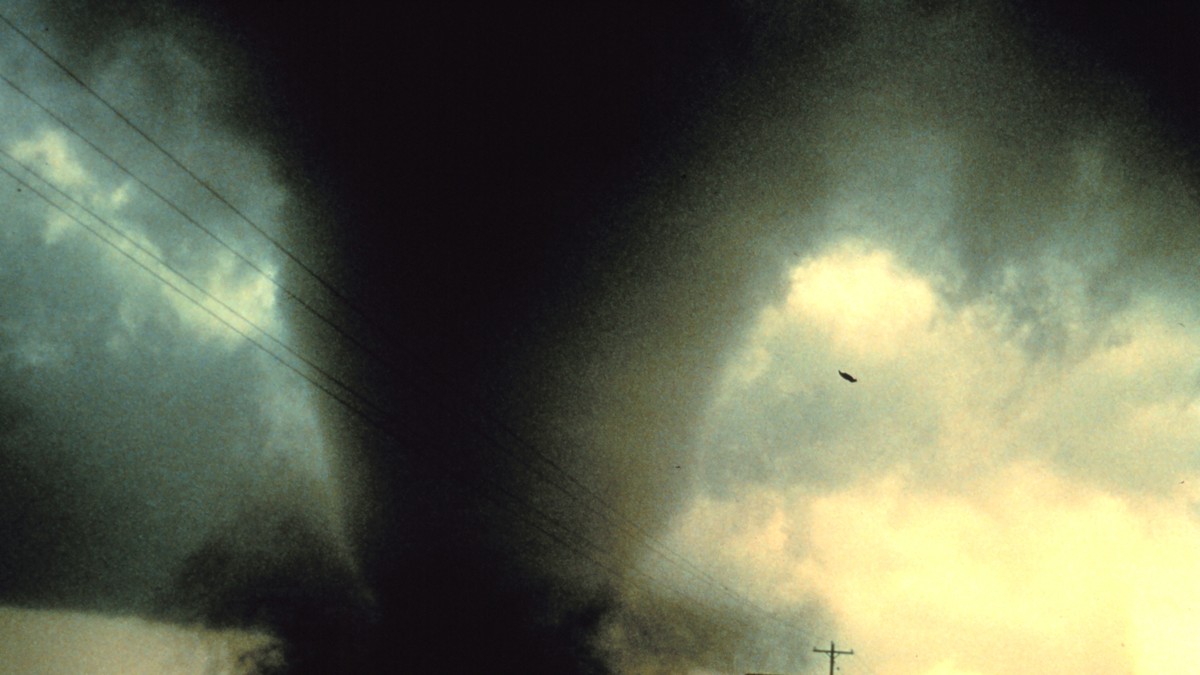
🌪️ Vortex Fluid Dynamics Monograph
A rigorous physical and mathematical treatise on tornadogenesis. We evaluate baroclinic versus barotropic vortex generation, the dynamic pipe effect, rear-flank downdraft thermodynamic profiles, two-cell vortex breakdown, and structural damage calibration via the Enhanced Fujita (EF) scale.
The terrestrial tornado represents the most concentrated, violent atmospheric vortex on planet Earth. Within a horizontal vortex core rarely exceeding several hundred meters in diameter, tangential wind speeds can surpass 135 meters per second (over 480 kilometers per hour), accompanied by extreme localized barometric pressure deficits dropping more than 80 to 100 hectopascals below ambient atmospheric pressure within a few seconds. Despite decades of intensive Doppler radar investigations, airborne probing, and high-resolution numerical fluid modeling, explaining precisely why certain rotating supercell storms spawn catastrophic tornadoes while seemingly identical storms fail to produce ground-level rotation remains one of the premier challenges in modern atmospheric science.
Tornadogenesis—the physical sequence of events culminating in the birth of a violent, surface-contact atmospheric vortex—requires a multi-scale transition. While mid-level mesocyclone rotation is easily established through the tilting and stretching of environmental horizontal wind shear, this mid-tropospheric rotation cannot simply descend to the ground on its own. Air at the planetary surface is constrained by friction and boundary conditions; it cannot spin up into a violent vortex without localized torque and non-hydrostatic vertical suction. Consequently, tornadogenesis is governed by complex low-level baroclinic vorticity generation, cold pool thermodynamics, and corner-flow vortex dynamics.
1. The Tornadogenesis Dilemma: Why Mid-Level Mesocyclones Cannot Reach the Ground
To understand the fundamental dilemma of tornadogenesis, one must examine the classical circulation theorem formulated by Vilhelm Bjerknes. In a frictionless barotropic fluid where density is solely a function of pressure, the Kelvin circulation around a closed material fluid contour is strictly conserved:
d(C) / dt = 0
Because an ascending convective updraft is composed entirely of air that originated near the surface and is accelerating upward, any closed material circuit drawn at the surface prior to storm initiation possesses zero vertical vorticity. Air that simply ascends into the updraft experiences stretching, but stretching can only amplify pre-existing vertical vorticity—it cannot create vertical vorticity where none initially existed at ground level! Therefore, purely buoyant updrafts cannot generate a surface tornado on their own. There must exist a downdraft mechanism capable of transporting air with newly generated horizontal or vertical vorticity downward to the ground.
2. Baroclinic Vorticity Generation and the Role of the RFD
The critical physical agent responsible for generating low-level vertical vorticity is the Rear-Flank Downdraft (RFD). As mid-tropospheric air is drawn downward along the backside of the mesocyclone, it passes through regions of intense hydrometeor evaporation and melting. This creates sharp horizontal temperature gradients across the downdraft boundary, with dense, chilled air on one side and buoyant, warm inflow air on the other.
Whenever surfaces of constant atmospheric pressure (isobars) intersect surfaces of constant atmospheric density (isopycnals), a baroclinic torque is generated according to the baroclinic solenoidal term of the vorticity equation:
[ (grad(rho) x grad(p)) / rho² ]
This density gradient causes denser cold air to sink while lighter warm air rises, generating powerful horizontal vorticity along the flanks of the descending RFD current. As this downdraft parcel plunges toward the ground and spreads out horizontally, these newly generated baroclinic vortex tubes are tilted into the vertical dimension upon encountering the surging updraft base. Once reaching the ground, intense vertical convergence beneath the rotating wall cloud stretches these vertical vortex filaments, compressing the circulation into a tight, violently rotating tornadic vortex.
Crucially, field campaigns such as the VORTEX projects (Verification of the Origins of Rotation in Tornadoes Experiment) demonstrated that the thermodynamic temperature of the RFD is the primary decider of tornadogenesis:
- Cold, Negatively Buoyant RFDs: If the RFD air is excessively chilled by catastrophic evaporation, the air parcel becomes overwhelmingly dense and negatively buoyant. When it strikes the ground, it rushes outward as an aggressive cold pool, undercutting the updraft and blowing away the low-level convergence zone before stretching can occur. Such storms fail to produce tornadoes.
- Warm, Buoyant RFDs: If the RFD parcel undergoes modest evaporative chilling or experiences adiabatic compressional warming during its descent, it reaches the ground only marginally cooler than the ambient inflow air (often less than 1 to 2 degrees Celsius deficit). This buoyant RFD air can be easily ingested and evacuated upward by the low-level mesocyclone updraft, enabling intense, sustained vortex stretching that culminates in violent tornadogenesis.
3. The Dynamic Pipe Effect and Vortex Breakdown Mechanics
The fluid mechanical process by which the rotating column descends from the mid-troposphere to establish ground contact is known as the Dynamic Pipe Effect (DPE). In a rotating fluid column, strong cyclostrophic balance develops between the inward-directed radial pressure gradient force and the outward-directed centrifugal force:
(1 / rho) * (dp / dr) = (v_theta² / r)
where v_theta is the tangential wind speed and r is the vortex radius. This cyclostrophic equilibrium prevents radial inflow into the core of the rotating cylinder, effectively transforming the vortex into a rigid, low-pressure pipe. Because air cannot enter laterally through the vortex walls, air can only enter through the open bottom of the pipe. This forces strong upward suction along the base of the cylinder, stretching and spinning up the air column immediately beneath it. Through this progressive mechanism, the rotating ‘pipe’ extends downward toward the surface until the vortex makes contact with the ground.
Vortex Core Breakdown: Transition from Single-Cell to Multi-Vortex Modes
As a tornado intensifies, its structural morphology evolves governed by the non-dimensional swirl ratio S, defined as the ratio of tangential velocity to mean axial updraft velocity (S = v_theta / 2w). When the swirl ratio is low (S < 0.5), the tornado operates as a single laminar convective column with a powerful axial upward jet along its centerline (a single-cell vortex).
However, as the swirl ratio increases past a critical threshold, the intense centrifugal force flings air outward from the core, creating an extreme central pressure depression. This low pressure induces a hydraulic shock wave known as vortex breakdown. The central upward jet reverses, transforming into a plunging downdraft along the central axis of the tornado, resulting in a two-cell vortex structure. If the swirl ratio climbs further (S > 1.0), the cylindrical shear sheet destabilizes via Kelvin-Helmholtz and barotropic instabilities, fracturing the main tornado into multiple smaller, intensely rotating sub-vortices—termed suction vortices. These sub-vortices rotate cyclonically around the common center of the tornado, generating localized wind swaths that exceed the parent tornado’s rotational speed by over 50 meters per second and creating devastating, looping cycloidal damage paths.
4. Low-Level Jet Coupling, Inflow Thermodynamics, and 0-1 km EHI
The likelihood of tornadogenesis is intimately tied to the thermodynamic and shear properties of the lowest 1,000 meters of the atmosphere. The nocturnal Low-Level Jet (LLJ)—a fast-moving river of air centered near 500 to 1,500 meters altitude across the Great Plains and Mississippi Valley—plays a dominant role in priming the tornadic environment. Driven by boundary layer decoupling following nocturnal radiational cooling and inertial oscillations around the Bermuda high-pressure ridge, the LLJ accelerates rapidly after sunset, reaching wind speeds of 20 to 35 meters per second.
This rapid wind acceleration dramatically expands the 0–1 km shear vector and creates extreme low-level Storm-Relative Helicity (0–1 km SRH > 200–300 m²/s²). Meteorologists synthesize this low-level kinematics with buoyancy using the Significant Tornado Parameter (STP) and the Energy-Helicity Index (EHI):
EHI (0-1 km) = [ CAPE * SRH(0-1 km) ] / 160,000
When 0–1 km EHI exceeds 2.0 to 4.0 in combination with low Lifting Condensation Levels (LCL < 800 meters), the boundary layer possesses high relative humidity and immense streamwise vorticity. Low cloud bases suppress evaporative chilling of the RFD, preserving the warm, buoyant downdraft pool required for flawless vortex stretching.
5. Damage Forensic Calibration: The Enhanced Fujita (EF) Scale
Because direct in situ measurement of tornadic wind speeds with standard anemometers is impossible—instruments are invariably destroyed or obliterated by flying debris—meteorologists determine tornado intensity through forensic structural damage analysis. Originally formulated in 1971 by Dr. Tetsuya Theodore Fujita (the Fujita Scale), the metric was comprehensively overhauled by structural engineers and meteorologists in 2007, establishing the operational Enhanced Fujita (EF) Scale.
The EF scale evaluates 28 distinct Damage Indicators (DIs)—ranging from single-family residences (FR12) and manufactured homes to electrical transmission towers, schools, and commercial warehouses. Each Damage Indicator is calibrated against specific Degrees of Damage (DOD), providing empirical wind speed estimates based on building construction quality:
| EF Rating | 3-Second Wind Gust Range | Structural Damage Thresholds (Single-Family Residence) | Forensic Structural Indicators |
|---|---|---|---|
| EF0 | 65 – 85 mph (105 – 137 km/h) | Light Damage: Loss of roof shingles, vinyl siding stripped, gutters bent | Small tree branches broken, shallow-rooted trees pushed over |
| EF1 | 86 – 110 mph (138 – 177 km/h) | Moderate Damage: Roof surface peeled, broken exterior windows, doors blown in | Mobile homes overturned or heavily damaged, attached carports destroyed |
| EF2 | 111 – 135 mph (178 – 217 km/h) | Considerable Damage: Roof structures torn off, exterior walls intact, foundation unshifted | Large trees snapped or uprooted, light-object missiles generated |
| EF3 | 136 – 165 mph (218 – 266 km/h) | Severe Damage: Entire exterior stories of well-built homes collapsed, top floors destroyed | Heavy vehicles lifted and tossed, metal transmission towers buckled |
| EF4 | 166 – 200 mph (267 – 322 km/h) | Devastating Damage: Well-constructed frame homes leveled completely, leaving flat slab | Vehicles thrown hundreds of meters, weak foundation structures swept clean |
| EF5 | > 200 mph (> 322 km/h) | Incredible Damage: Strong frame houses completely swept away, clean concrete slabs | Asphalt gouged from roads, bark stripped completely from trees, high-rise structural collapse |
6. Ground Scouring, Corner Flow, and Structural Failure Mechanics
At the immediate interface between the violent tornado core and the ground resides a specialized boundary layer known as the corner flow region. Because surface friction retards the tangential velocity of the air, the centrifugal force holding air out of the vortex core is weakened near the ground. However, the inward radial pressure gradient remains virtually unaffected. Consequently, strong, un-arrested radial inflow shoots inward toward the center of the vortex right at ground level, accelerating to speeds far exceeding the ambient wind before erupting vertically in a concentrated annular jet.
This intense corner flow produces extraordinary physical phenomena observed exclusively in violent EF5 tornadoes: trench scouring (where vegetative sod, topsoil, and even asphalt paving are gouged out to depths of several feet), total tree debarking (where airborne gravel and sand carried at 100 m/s sandblast the bark completely off hardwood trees), and structural anchorage failure. Forensic investigations by the Wind Science and Engineering Research Center at Texas Tech University revealed that residential structures fail catastrophically not from explosive barometric pressure differences, but from aerodynamic lift: when windward windows fail, internal pressurization combined with aerodynamic uplift across roof eaves lifts the roof structure off the walls, causing unbraced load-bearing walls to collapse outward and disintegrate.
7. Numerical Simulation Frontiers: Large Eddy Simulations (LES) and Grid Resolving Models
In recent years, the understanding of tornadogenesis has been propelled forward by petascale supercomputing and ultra-high-resolution Large Eddy Simulations (LES). Pioneered by atmospheric modelers such as Leigh Orf and George Bryan, these simulations achieve grid spacings down to 10 to 30 meters, resolving individual turbulent eddies, internal downdraft boundaries, and the evolving tornadic vortex tube itself.
These computational simulations have unveiled previously undetectable fluid phenomena, such as the Streamwise Vorticity Current (SVC)—a concentrated horizontal tube of streamwise vorticity that forms along the northern flank of the cold pool beneath the forward-flank downdraft. The SVC acts as a high-speed rotational pipeline, feeding pure cyclonic rotation directly into the base of the supercell updraft. High-performance models demonstrate that when the SVC couples synchronously with a warm, buoyant rear-flank downdraft, the vortex stretches explosively, triggering near-instantaneous tornadogenesis. These numerical discoveries are actively guiding the next generation of Warn-on-Forecast (WoF) computer prediction systems, with the goal of increasing tornado warning lead times from minutes to hours.
Ultimately, tornadogenesis represents the culmination of a multi-scale atmospheric energy cascade. From the synoptic-scale baroclinic cyclone to the mesoscale supercell updraft, and finally to the microscale corner-flow vortex at ground level, kinetic energy is continuously funneled into an increasingly concentrated volume. Continued field research and high-resolution numerical experimentation remain essential to deciphering the fine-scale boundary layer mechanics that separate benign rotating storms from violent tornadic disasters.