🌌 Upper Atmospheric Physics Treatise
A rigorous scientific examination of cloud formations existing beyond the troposphere. We evaluate Type I and Type II Polar Stratospheric Clouds (PSCs / Nacreous clouds), heterogeneous chlorine activation driving the Antarctic Ozone Hole, and the mesospheric physics of Noctilucent Clouds (NLCs / Polar Mesospheric Clouds) at the edge of space.
In standard terrestrial meteorology, clouds are traditionally understood as tropospheric phenomena, confined beneath the thermal capping inversion of the tropopause. Because the stratosphere is characterized by an inverted temperature profile—where temperatures increase with altitude due to ultraviolet absorption by ozone—it is an inherently stable, stratified atmospheric layer devoid of vigorous vertical convective mixing. Moreover, the stratosphere and mesosphere are hyper-arid environments; water vapor concentrations in the middle stratosphere rarely exceed 3 to 5 parts per million by volume (ppmv), representing an environment hundreds of times drier than the Sahara Desert. Under ordinary conditions, cloud formation at these altitudes is thermodynamically impossible.
However, under extraordinary seasonal conditions in Earth’s polar winter and summer mesosphere, temperatures plunge to the most frigid extremes recorded on the planet. At these thermodynamic thresholds, even infinitesimal traces of water vapor, nitric acid, and sulfuric acid condense into rare, ethereal cloud sheets: Polar Stratospheric Clouds (PSCs) in the lower stratosphere (15 to 25 km altitude) and Noctilucent Clouds (NLCs) in the mesopause region (80 to 85 km altitude). Far from being mere aesthetic curiosities, these upper atmospheric clouds play monumental roles in global atmospheric chemistry, serving as the catalytic engines of stratospheric ozone depletion and acting as sensitive sentinels of global climate change.
1. Polar Stratospheric Clouds (PSCs): Thermodynamic Regimes and Classification
Polar Stratospheric Clouds form exclusively inside the deep winter polar vortex, primarily over Antarctica and intermittently over the Arctic. When the polar regions enter months of continuous winter darkness, lack of solar heating combined with strong radiative cooling causes temperatures within the isolated circumpolar vortex to drop below -78 degrees Celsius (195 Kelvin). At these temperatures, chemical condensation occurs, forming PSCs that are categorized into distinct microphysical classes based on composition and phase:
| PSC Classification | Trivial / Common Name | Altitude Range | Chemical Composition | Formation Temperature | Visual & Chemical Impact |
|---|---|---|---|---|---|
| Type Ia (Crystalline) | Nitric Acid Trihydrate (NAT) | 15 – 25 km | HNO3 · 3H2O (Crystalline flakes) | T < 195 K (-78°C) | Visually tenuous, yellowish haze; drives stratospheric denitrification via sedimentation |
| Type Ib (Liquid) | Supercooled Ternary Solution (STS) | 15 – 25 km | H2SO4 / HNO3 / H2O liquid droplets | T < 192 K (-81°C) | Optically subtle; highly efficient surface for heterogeneous chlorine activation |
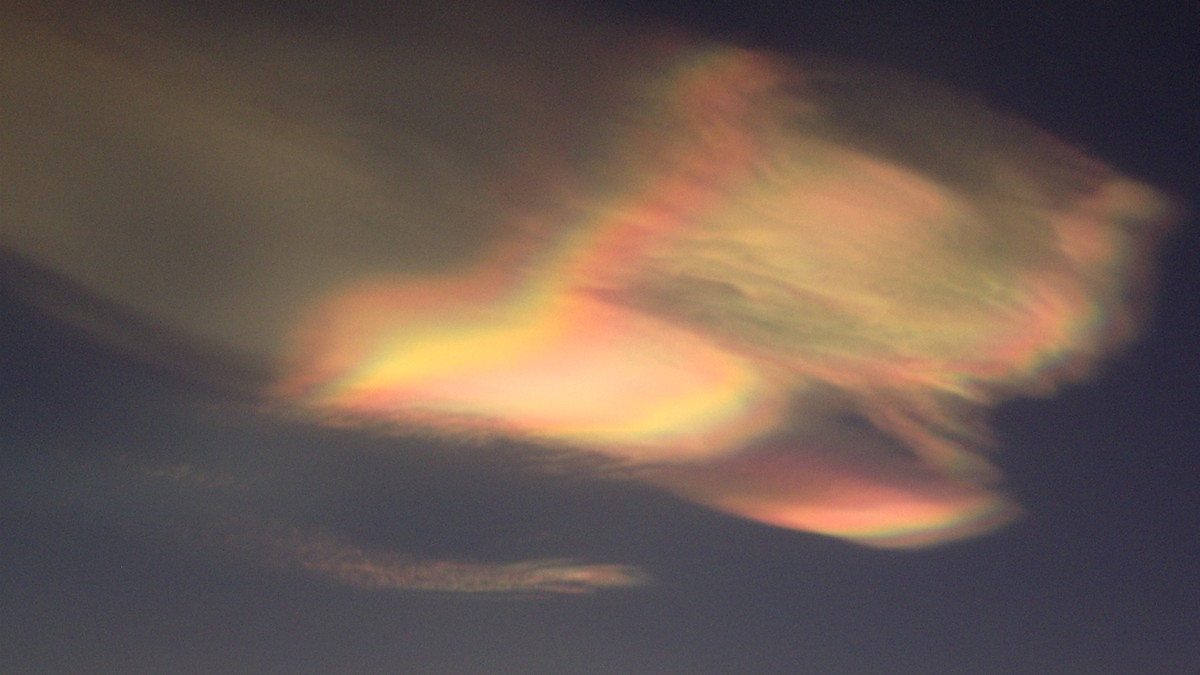
| Type II (Crystalline Ice) | Nacreous / Mother-of-Pearl Clouds | 20 – 30 km | Pure H2O Crystalline Ice Crystals | T < 188 K (-85°C) | Spectacular iridescent mother-of-pearl pastel colors; extreme ozone depletion catalyst |
| Noctilucent (NLC / PMC) | Polar Mesospheric Clouds | 80 – 85 km | H2O Ice condensed on meteor smoke | T < 130 K (-143°C) | Electric-blue shimmering veils visible during deep nautical twilight at high latitudes |
2. The Ozone Hole Catalyst: Heterogeneous Halogen Chemistry on PSC Surfaces
The profound historical and environmental significance of Polar Stratospheric Clouds was uncovered during the 1980s following the discovery of the catastrophic springtime Antarctic Ozone Hole by British Antarctic Survey scientists Joe Farman, Brian Gardiner, and Jonathan Shanklin. Atmospheric chemists initially struggled to explain why ozone depletion was concentrated exclusively over polar regions when anthropogenic chlorofluorocarbons (CFCs) were distributed globally throughout the atmosphere.
The answer lies in the unique heterogeneous chemistry that occurs exclusively on the solid and liquid surfaces of Polar Stratospheric Clouds. In the unperturbed stratosphere, chlorine atoms released from CFCs are locked into stable, unreactive ‘reservoir species’—primarily chlorine nitrate (ClONO2) and hydrogen chloride (HCl). Under normal gaseous phase conditions, these reservoir compounds do not react with ozone. However, during the polar winter night, PSC particles provide catalytic surfaces that facilitate rapid, non-photochemical heterogeneous reactions between these reservoir species:
HCl (adsorbed) + ClONO2 (gas) –> Cl2 (gas) + HNO3 (solid/aerosol)
ClONO2 (gas) + H2O (ice) –> HOCl (gas) + HNO3 (solid/aerosol)
Through these heterogeneous reactions, the benign reservoir species are converted into molecular chlorine gas (Cl2) and hypochlorous acid (HOCl), which accumulate inside the dark polar vortex throughout the winter. Simultaneously, the nitric acid (HNO3) produced remains trapped within the large NAT and STS cloud particles. When these heavy particles grow, gravitational sedimentation causes them to fall out of the stratosphere—a process termed denitrification. Without nitrogen dioxide (NO2) present in the stratosphere, the atmosphere cannot neutralize active chlorine back into harmless chlorine nitrate.
When the polar spring sun first peeks over the horizon in September, ultraviolet photons immediately photolyze the accumulated molecular chlorine gas, cleaving Cl2 into free chlorine radicals (Cl*). A single chlorine radical can destroy over 100,000 ozone molecules through a catalytic chain cycle before being neutralized. Because denitrification has eliminated reactive nitrogen compounds, the catalytic ozone destruction cycle runs unchecked, decimating 50% to 70% of the total ozone column over Antarctica within weeks.
3. Optical Physics of Nacreous Formations: Structural Color and Iridescence
Among all cloud formations on Earth, Type II Nacreous Clouds are widely regarded as the most visually breathtaking. Observed primarily in high-latitude regions such as Scandinavia, Iceland, Alaska, and the Antarctic Peninsula, nacreous clouds exhibit brilliant, shimmering pastel colors—luminous pinks, violets, turquoises, and incandescent golds—that resemble mother-of-pearl (hence the Latin root nacre).
The exceptional luminosity and coloration of nacreous clouds are governed by two physical factors: extreme altitude illumination and uniform particle diffraction. Because nacreous clouds reside at altitudes between 20 and 30 kilometers, they remain illuminated by direct sunlight long after the sun has set below the horizon for a ground observer. Against the inky blackness of nautical and astronomical twilight, these clouds blaze with direct solar light.
Furthermore, because the conditions required to reach ice frost point (T < 188 K) in the stratosphere are typically achieved via localized mountain gravity waves (lee waves) forced over high topographical barriers like the Scandinavian mountains, droplet and crystal growth occurs rapidly in a localized, uniform cooling zone. Consequently, nacreous clouds are composed of exceptionally monodisperse ice crystals measuring approximately 1 to 2 micrometers in diameter. When sunlight strikes this uniform crystalline matrix, light waves diffract with pristine coherence, creating intense, broad bands of pure structural color that far surpass the intensity of ordinary tropospheric iridescence.
4. Noctilucent Clouds (NLCs): Ice Crystals at the Edge of Space
Ascending further through the atmosphere to the mesopause—the boundary between the mesosphere and the thermosphere at 80 to 85 kilometers altitude—we encounter Noctilucent Clouds (Latin for ‘night-shining’), known scientifically as Polar Mesospheric Clouds (PMCs) when observed from orbit. Residing at the physical frontier of outer space, noctilucent clouds are the highest clouds in Earth’s atmosphere, floating well above 99.999% of the planet’s atmospheric mass.
The Coldest Place on Earth: Mesospheric Dynamics
Paradoxically, Noctilucent Clouds form exclusively during the height of polar summer. While the surface experiences continuous solar heating during the summer solstice, the global mesospheric circulation operates in reverse. Large-scale atmospheric gravity waves propagating upward from the troposphere drive a vigorous poleward and upward overturning circulation known as the Brewer-Dobson mesospheric branch. Over the summer pole, air ascends dynamically, undergoing intense adiabatic expansion that cools the mesopause region down to an astonishing 120 to 130 Kelvin (-153°C to -143°C)—the coldest natural temperatures encountered anywhere on planet Earth.
At these cryogenic temperatures, even the minuscule water vapor mixing ratio of the mesosphere (approximately 1 to 3 ppmv) becomes supersaturated. However, because terrestrial aerosols cannot reach this extreme altitude, heterogeneous nucleation relies on an extraterrestrial source: meteoric smoke particles. Every day, dozens of tons of interplanetary meteoroids ablate upon entering Earth’s upper atmosphere, producing a fine vapor of iron, magnesium, and silicon atoms that recondenses into nanometer-sized cosmic dust grains. These meteor dust particles act as the nuclei upon which mesospheric water vapor crystallizes into ice.
Visual Signature and Climate Sentinel Role
Noctilucent clouds are visible from the ground only between latitudes 50 degrees and 65 degrees during deep summer twilight, when the sun is between 6 and 16 degrees below the horizon. The clouds reflect sunlight from the underside of the curvature of the Earth, presenting an unmistakable aesthetic: electric-blue or silvery-white shimmering ripples, delicate herringbone waves, and billows caused by Kelvin-Helmholtz instabilities at the edge of space. The characteristic electric-blue color is not Rayleigh scattering; rather, it is caused by the absorption of red and orange wavelengths of sunlight as the beams pass through the stratospheric ozone layer (Chappuis band absorption) before illuminating the mesospheric ice veil.
In recent decades, satellite observations from NASA’s AIM (Aeronomy of Ice in the Mesosphere) mission have revealed that noctilucent clouds are becoming systematically brighter, more frequent, and are migrating to lower latitudes. Atmospheric scientists recognize NLCs as sensitive indicators of global climate change. Increasing concentrations of atmospheric methane (CH4) from agricultural and industrial sources ascend into the stratosphere and mesosphere, where methane undergoes photochemical oxidation, producing two molecules of water vapor for every oxidized methane molecule. This increases mesospheric humidity. Simultaneously, rising concentrations of greenhouse gases in the lower atmosphere trap heat near the surface, which causes the upper mesosphere to undergo radiative cooling, expanding the thermodynamic window for mesospheric ice crystallization.
5. Historical Milestones and Spaceborne Remote Sensing of Upper Clouds
The observational history of noctilucent clouds is intimately linked to monumental geological events. The earliest documented scientific observations of NLCs date to the summer of 1885, two years after the cataclysmic volcanic eruption of Krakatoa in Indonesia in August 1883. Krakatoa blasted an estimated 20 million tons of pulverized rock and volcanic sulfur aerosol into the stratosphere, generating incandescent optical twilights across the globe. German astronomer Otto Jesse and British naturalist Robert Leslie independently noticed luminous, silver-blue fibrous bands glowing in the midnight northern sky. Jesse established the first network of synchronized photographic triangulation stations, accurately calculating the clouds’ altitude at 82 kilometers—a measurement that stunned the nineteenth-century scientific community by proving the presence of condensing atmospheric matter near the boundary of outer space.
In the twenty-first century, research into polar stratospheric and mesospheric clouds has been revolutionized by dedicated satellite remote sensing systems. NASA’s Aeronomy of Ice in the Mesosphere (AIM) satellite, launched in 2007, was the first orbital platform specifically tasked with imaging noctilucent clouds. Operating the Cloud Imaging and Particle Size (CIPS) ultraviolet panoramic camera and the Solar Occultation for Ice Experiment (SOFIE), AIM has provided unprecedented quantitative measurements of ice crystal radii, water vapor mixing ratios, and temperature profiles across the polar summer mesopause. Simultaneously, limb-sounding instruments aboard NASA’s Aura satellite, specifically the Microwave Limb Sounder (MLS), and the Stratospheric Aerosol and Gas Experiment (SAGE III) on the International Space Station, continually monitor polar stratospheric clouds, measuring NAT and STS optical extinction and tracking real-time halogen activation. These satellite networks have confirmed that upper-atmospheric clouds serve as irreplaceable early warning systems for the chemical and thermodynamic evolution of Earth’s middle and upper atmosphere.
6. Orographic Gravity Waves and Hydraulic Jumps in the Stratosphere
A crucial physical mechanism facilitating Type II Nacreous cloud formation in the lower stratosphere is the vertical propagation of orographic gravity waves. When strong, stratified tropospheric winds encounter high topography—such as the Scandinavian mountain range or the Antarctic Peninsula—the air is displaced vertically over the barrier, initiating internal buoyancy oscillations governed by the Brunt-Väisälä frequency N.
The vertical propagation of these mountain waves into the stratosphere depends on the vertical profile of the Scorer parameter l²(z), defined mathematically as:
l²(z) = [ N² / U² ] – [ (d²U / dz²) / U ]
where U is the horizontal wind velocity normal to the ridge and d²U/dz² is the vertical wind curvature. When the Scorer parameter decreases moderately with altitude, mountain waves propagate deep into the stratosphere without trapping. As the wave crests penetrate into the 20 to 25 km altitude range, the air undergoes severe localized adiabatic expansion. This adiabatic lifting cools the stratospheric air parcel by 10 to 15 degrees Celsius below the ambient synoptic temperature, pushing it beneath the critical 188 Kelvin threshold needed to nucleate pure water ice crystals (Type II PSCs), even if the surrounding synoptic vortex remains several degrees above the frost point. Downwind of the mountain ridge, the plunging air creates a hydraulic jump, terminating the cloud abruptly with razor-sharp margins that shimmer with iridescent colors across the twilight sky.